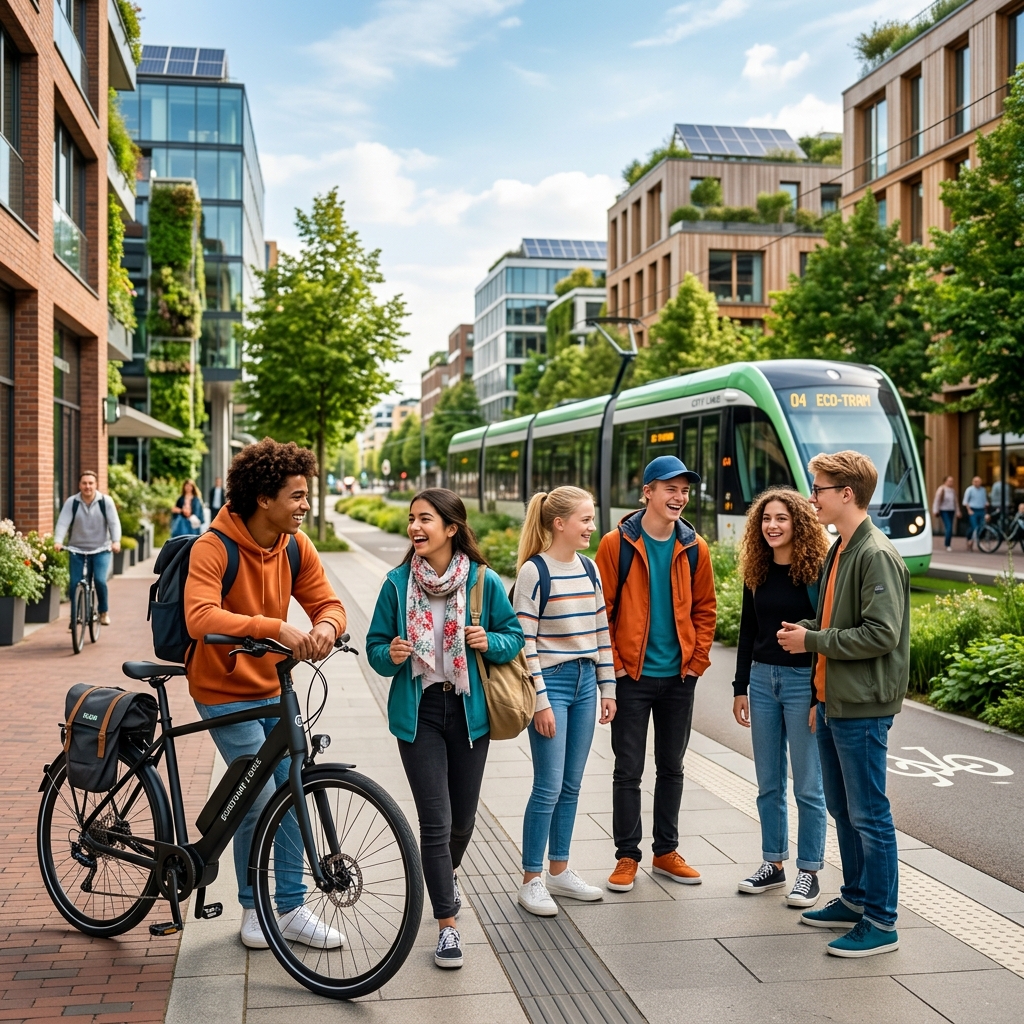
The 15-minute city concept promotes proximity, accessibility and decarbonisation — but it largely overlooks the specific mobility needs and aspirations of adolescents aged 14–18 transitioning into adulthood.
in Lisbon and Holbæk, and open-source digital tools, the project puts young people at the centre of planning processes.
How can adolescent-inclusive urban mobility systems support sustainable transitions and strengthen young people's engagement in shaping their cities?
Background research, adolescent mobility data collection, governance mapping and benchmarking of policies and urban systems across four cities.
M1 – M16Urban Living Labs in Lisbon and Holbæk, participatory workshops with adolescents, and development of the HANGOUT Atlas and Policy Toolkit.
M13 – M34Engagement with the DUT Knowledge Hub, policy briefs, peer-reviewed publications, and open data to support cities across Europe and beyond.
M1 – M36Collect and analyse data on adolescents' lived accessibility experiences across four European cities, beyond school commutes.
Identify and address structural, institutional, and spatial barriers limiting adolescents' access to sustainable mobility options.
Actively engage adolescents through ULLs in Lisbon and Holbæk, with Adolescent Councils driving co-creation of solutions.
Deliver the open-source HANGOUT Atlas and Policy Toolkit for adolescent-inclusive urban planning, tested across multiple cities.
Primary data collection, travel behaviour modelling and equity impact assessment cross-cities.
Active engagement with DUT's 15-Minute City Knowledge Hub — co-authored outputs, policy briefs, and science-to-policy translation. Led by IST-ID (Filipe Moura, DUT Ambassador).